Instructional Design Document
Credentials:
Link to the Google class: https://classroom.google.com/c/Njc1NDQ4NDA0NTAx
Login: edxldt400.2024@gmail.com
Password: GOedX+LDT400
Discussion Without Rubrics
Non rubric based old version of the prompt:
List at least two frontend frameworks which you would use in your work. Discuss with your classmates, that’s the most important feature of framework.
Anyone in the course is encouraged to participate.
Discussion Prompt with Rubrics:
Considering the rubrics, articulate your reasons for selecting at least two frontend frameworks that you would utilize in your work. Engage with your classmates to discuss the pivotal features of these frameworks and evaluate their significance in your projects.
Anyone in the course is encouraged to participate.
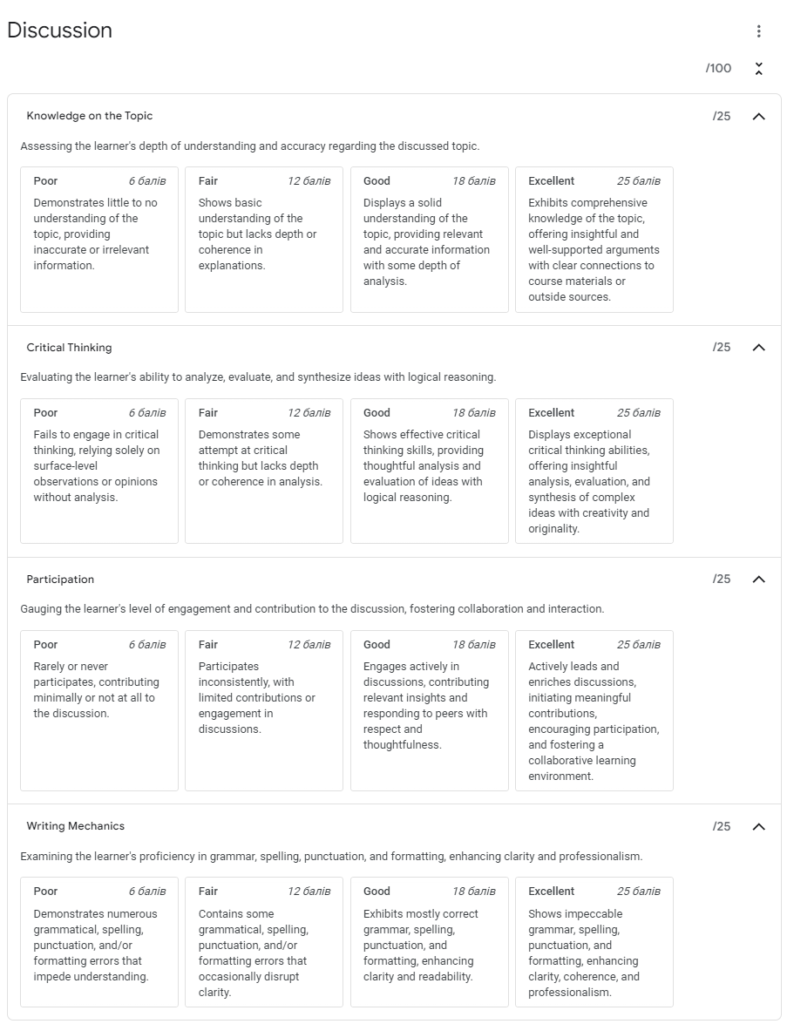
Assessment criteria:
- Knowledge on the Topic: Participants will demonstrate their understanding of frontend frameworks by listing at least two options and explaining their relevance to their work.
- Critical Thinking: Participants will engage in critical thinking by discussing the most important features of the chosen frameworks and evaluating their significance in the context of their projects.
- Participation: Engagement in the discussion will be assessed based on the frequency, depth, and relevance of contributions made by each participant.
- Writing Mechanics: Responses should demonstrate clear and effective communication, with attention to grammar, spelling, punctuation, and formatting.
Criteria are equally weighted and each criterion has four rating levels:
- Poor
- Fair
- Good
- Excellent
Check the table for points and rubric descriptors (click the image to see full version).
Assignment Rubrics
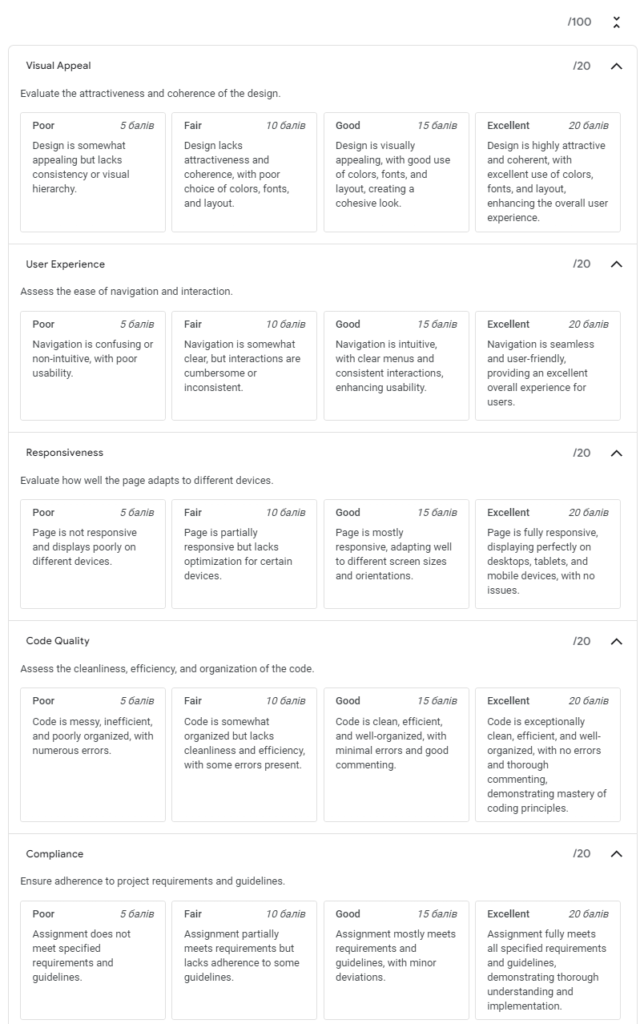
This assignment will be assessed by the following criteria, weighted equally in the overall score:
- Overall Visual Appeal: Evaluate the attractiveness and coherence of the design.
- User Experience: Assess the ease of navigation and interaction.
- Responsiveness: Evaluate the adaptability of the page across different devices.
- Code Quality: Assess the cleanliness, efficiency, and organization of the codebase.
- Compliance with Requirements: Ensure adherence to the specified project requirements and guidelines.
Each criteria has four rating levels:
- Poor
- Fair
- Good
- Excellent
Check the table for points and rubric descriptors (click the image to see full version).
Reflection
Rubrics for discussion and assignments offer clarity on expectations, guide assessment, and ensure fairness. They help students understand criteria for success and provide instructors with consistent evaluation tools.
Creating rubrics for discussions and assignments was insightful, helping to define clear expectations and assessment criteria. By analyzing rubric data, I can identify areas of strength and improvement in student performance. This feedback informs adjustments to course materials, instructional methods, and assessment strategies, enhancing future learning experiences.