Behaviorism is a school of psychology that studies observable behavior, as opposed to internal mental states such as thoughts, emotions, and intentions. It is based on the idea that behavior can be studied and modified through rewards and punishments. Behaviorists believe that all behavior is learned through the environment, either through reinforcement or punishment. They emphasize the importance of understanding how reinforcement and punishment shape behavior, as well as how different stimuli can trigger certain behaviors.
Classical conditioning
At the end of 19th century the famous physiologist Pavlov conducted an experiment with dogs, in which he paired a neutral stimulus (the bell) with an unconditioned stimulus (dog food) that naturally provoked an unconditioned response (saliva).
This allowed the neutral stimulus to become a conditioned stimulus, eliciting a conditioned response similar to the original unconditioned response (Walinga and Stangor, 2014).
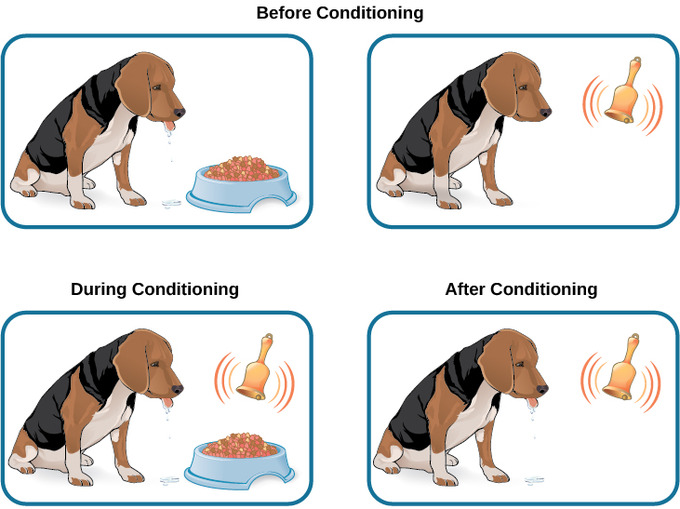
Image Source
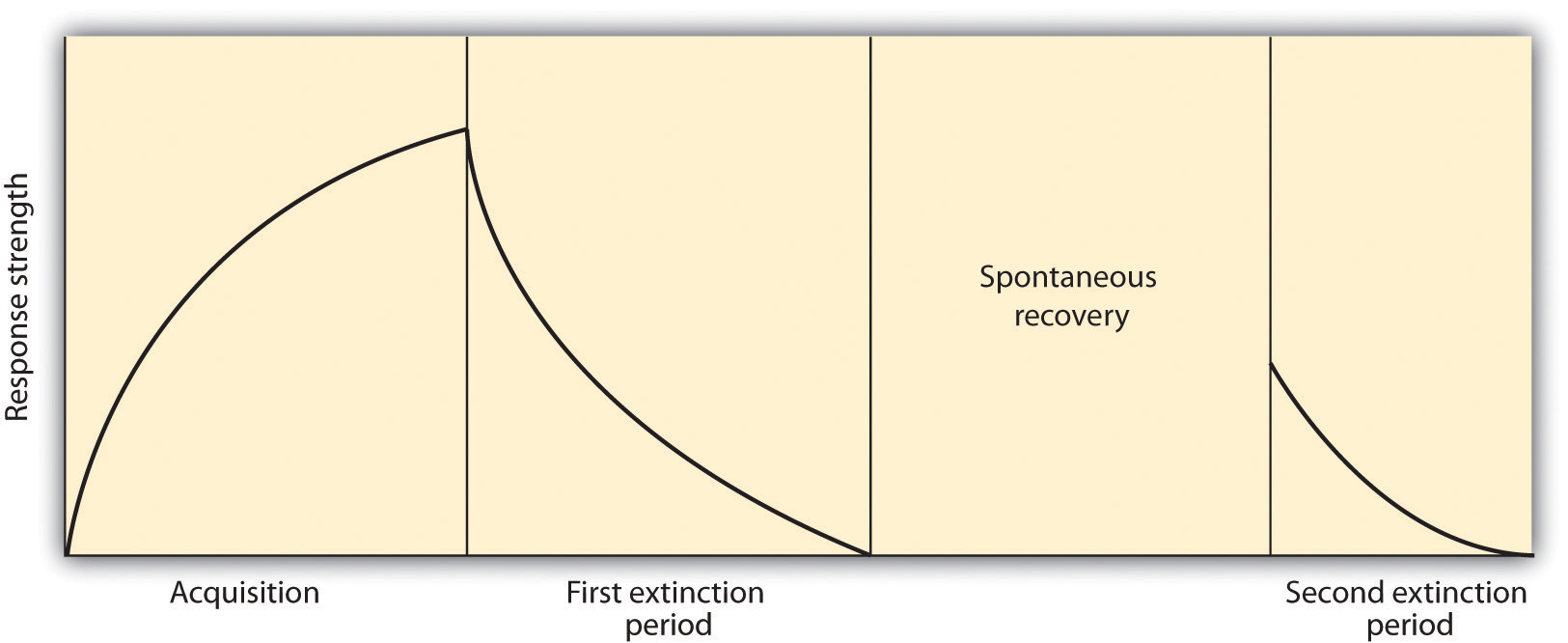
Image Source
Extinction of Conditioning
Conditioned response doesn’t last forever. If not confirmed (unconditioned stimulus is not presented together with conditioned one) it rapidly decreases, this process is called extinction. However it is possible, that the response to the conditioned stimulus increases again after extinction. This process is called spontaneous recovery.
Generalization vs Discrimination
There are two terms that are related to conditioning: Generalization and Discrimination.
- Generalization is the process of applying a learned behavior to similar situations.
- Discrimination in behaviorism is the process of an individual or group learning to distinguish between different stimuli and responding differently to each one.
Second-order conditioning
Second-order conditioning is a type of learning that occurs when an initially neutral stimulus (such as a sound) is associated with an unconditioned stimulus (such as food) that has already been associated with another neutral stimulus (such as a light). This type of learning allows the organism to form an association between two previously unrelated stimuli.
Operant conditioning
Operant conditioning is a type of learning in which behavior is modified by its consequences. Experiments describing operant conditioning were conducted by B.F. Skinner and Edward L. Thorndike in 1930s. They tested reactions of cats and rats on positive and negative situations, such as feeding electric shock.
Based on experiments it was discovered that reinforcement and punishment can be used to shape behavior. Reinforcement is a reward for desired behavior, while punishment is an unpleasant consequence for undesired behavior.
- Positive reinforcement occurs when a response is rewarding. It increases the frequency of that response (behavior).
- Negative reinforcement occurs when a response is followed by the removal of an unfavorable event, thereby increasing the frequency of the original behavior.
- Positive punishment occurs when a response is followed by an unfavorable outcome. It decreases the frequency of that response (behavior).
- Negative punishment occurs when a response is followed by the removal of a favorable outcome, thereby reducing the original behavior’s frequency.
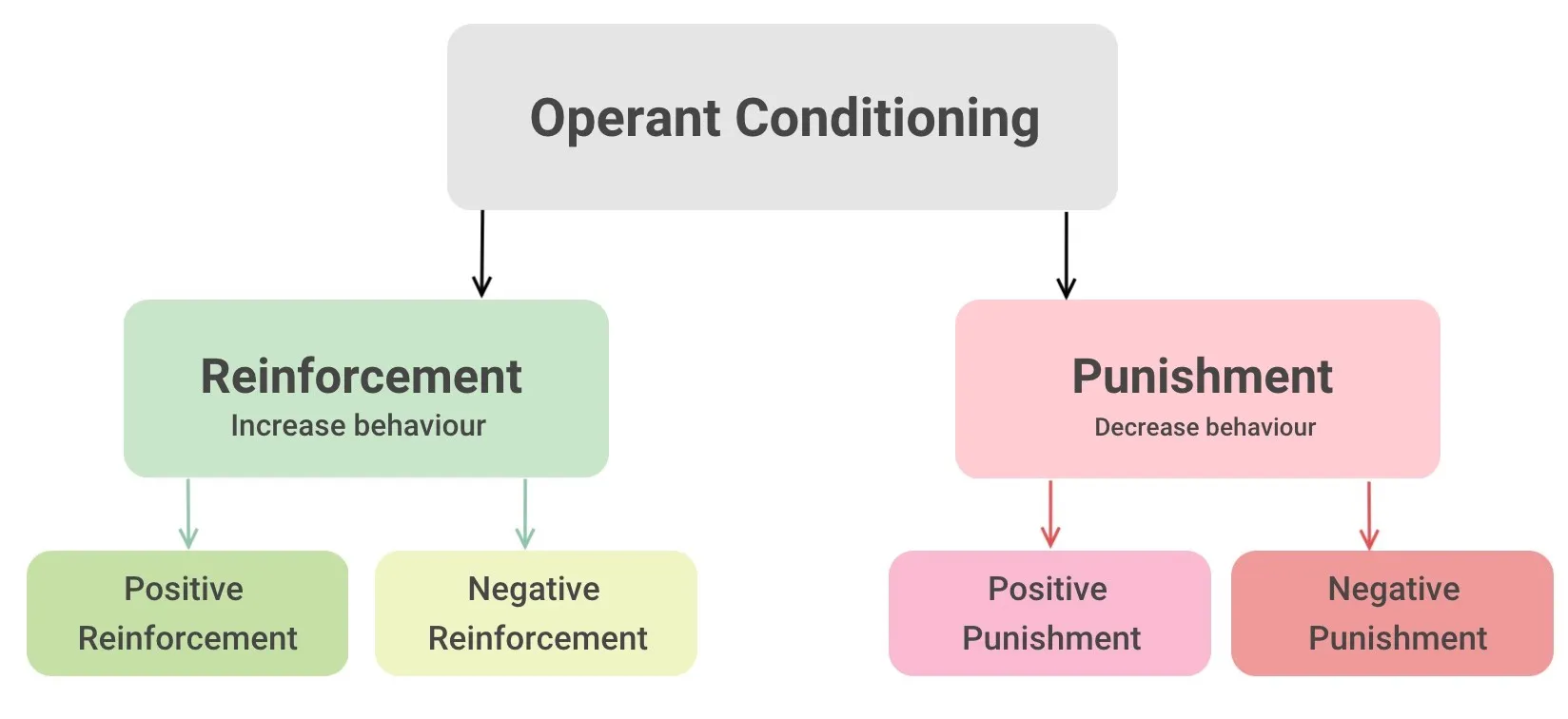
Image Source
Behaviorism in Education
Strengths in Education
- results of learning are observable and measurable
- motivation drive students to study better
- relatively fast building of stimuli – response relations
Limitations in Education
- failures demotivate students and may rather cause negative response (fear of failure)
- reward should be valuable enough to motivate all students in group
- stimuli – response relation weakens with time and should be confirmed regurarly
Implications for Instructional Design
Behavioristic approach can be used for:
- memorizing tasks (facts, formulas, words and phrases of foreign language)
- quizes and A/B/C tests
- gamification (making lerning process more attractive)
It can not be used for complicated tasks that require higher thinking.
Citations:
Cherry, K. (2022).What Is Behaviorism? Verywell Mind. https://www.verywellmind.com/behavioral-psychology-4157183
Walinga J. and Stangor C. (2014) Introduction to Psychology – 1st Canadian Edition https://opentextbc.ca/introductiontopsychology/
Cherry, K. (2021). How Extinction Is Defined in Psychology. Verywell Mind. https://www.verywellmind.com/what-is-extinction-2795176
Kumar V. (2020) 14 Best Examples Of Operant Conditioning. Ranked Red https://www.rankred.com/examples-of-operant-conditioning-1/
McLeod, S. (2018) What Is Operant Conditioning and How Does It Work? https://www.simplypsychology.org/operant-conditioning.html